
Picking a vintage streetwear direction feels overwhelming when you’re staring at decades of iconic looks, each with its own rules, icons, and energy. The 1980s, 1990s, and 2000s each built a completely different visual language, and choosing the wrong combination can make your fit look like a costume rather than a statement. But here’s the thing: vintage streetwear isn’t just about wearing old clothes. It’s about channeling the attitude of a specific era and making it yours. This guide breaks down each era’s signature codes, must-have pieces, and the smartest ways to mix them into a look that’s bold, personal, and impossible to ignore.
Table of Contents
- How to decode vintage streetwear eras
- Key staples from each era: Mix, layer, and stand out
- Accessories that make or break your streetwear statement
- Era mashups: How to personalize vintage streetwear
- Quick comparison: Era essentials at a glance
- Our take: Don’t get stuck on ‘pure’ era loyalty
- Find your vintage era staples at VibeVaultSupply
- Frequently asked questions
Key Takeaways
| Point | Details |
|---|---|
| Era codes matter | Each vintage streetwear era has signature fits and graphics to guide your choices. |
| Start with essentials | Build your look on classic staples like baggy jeans, graphic tees, or statement sneakers. |
| Accessories amplify vibe | The right cap, chain, or wristband elevates any streetwear outfit. |
| Mix for uniqueness | Combining touches from different eras helps you stand out with confidence. |
| Confidence is key | Wear your chosen era or mashup boldly—attitude makes the difference. |
How to decode vintage streetwear eras
Now that we’ve previewed what’s ahead, let’s break down the differences among the main vintage streetwear eras so you can decide which direction fits your vibe.
Streetwear didn’t appear out of nowhere. It grew from real subcultures, each one reacting to the world around it. The 1980s were all about skate culture, early hip-hop, and graffiti art bleeding into clothing. Workwear fabrics like denim and canvas got repurposed into street-ready fits. Brands were secondary. Attitude was everything.
The 1990s shifted the energy hard. Oversized fits took over, graphics got bolder, and logos became the main event. This was the golden era of underground fashion, where what you wore signaled which crew you ran with. Skate brands, hip-hop labels, and sportswear giants all competed for real estate on your chest. As streetwear history shows, vintage streetwear era styling leans into specific era codes, with the 1990s reading as baggier, more graphic, and workwear-adjacent compared to later decades.
Then came the 2000s. Louder branding, metallics, velour, and what people now call Y2K aesthetics pushed everything further. Bling became a lifestyle, not just an accessory. Futuristic silhouettes mixed with flashy logos in a way that felt chaotic and intentional at the same time.
“The era you choose isn’t just a fashion decision. It’s a statement about what kind of energy you want to put into the world.”
Here’s a quick side-by-side breakdown:
| Era | Core influences | Signature fits | Key graphics |
|---|---|---|---|
| 1980s | Skate, hip-hop, graffiti | Slim to straight cuts, workwear | Hand-drawn, DIY, minimal |
| 1990s | Hip-hop, skate, underground | Baggy, oversized, layered | Bold logos, large prints |
| 2000s/Y2K | Pop culture, bling, futurism | Wide silhouettes, velour, shiny | Big branding, metallic, loud |
The retro graphic tee influences that defined the 1990s are still some of the most recognizable in streetwear today. And if you lean toward the louder side, multicolor logo tees capture that 2000s energy without looking like you raided a time capsule.
Key differences to keep in mind:
- 1980s: Raw, rebellious, DIY energy with workwear roots
- 1990s: Oversized everything, graphic-heavy, logo-forward
- 2000s: Maximum volume, bling aesthetics, Y2K chaos
Key staples from each era: Mix, layer, and stand out
With a clear understanding of era vibes, let’s get specific about must-have pieces and how to mix them up for your own signature style.
Every era has its non-negotiables. These are the pieces that, when worn correctly, instantly signal which world you’re pulling from. Getting these right is the foundation of any strong vintage streetwear look.
The 1990s, widely considered the birth of modern streetwear, was rooted in skate, hip-hop, graffiti, and DIY culture, with baggy jeans and oversized tees as the uniform. This wasn’t accidental. Oversized fits communicated freedom, rebellion, and a rejection of corporate dress codes.
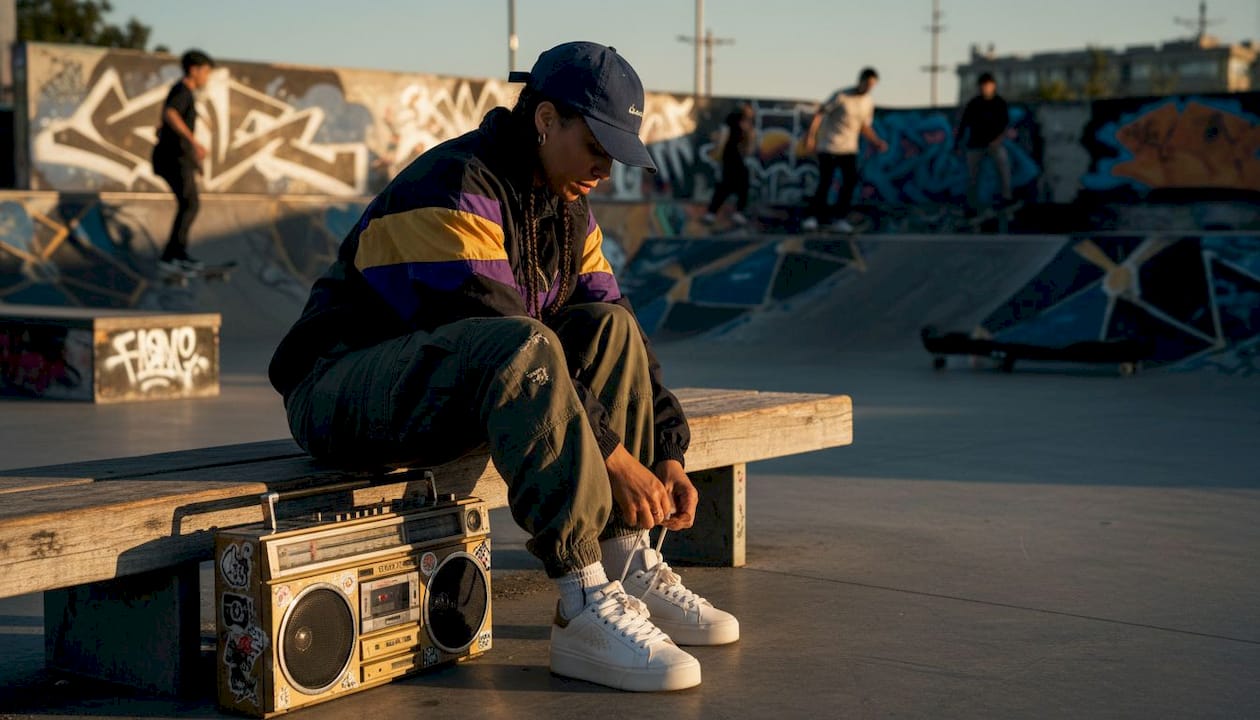
Here’s a breakdown of core pieces by era:
| Era | Bottoms | Tops | Outerwear | Footwear |
|---|---|---|---|---|
| 1980s | Straight-leg jeans, work pants | Basic tees, flannels | Denim jackets, bombers | Chunky sneakers, boots |
| 1990s | Baggy jeans, cargo pants | Oversized graphic tees, hoodies | Sportswear jackets, windbreakers | Classic skate shoes, high-tops |
| 2000s | Wide-leg jeans, velour tracksuits | Logo tees, fitted caps | Track jackets, puffer vests | Chunky sneakers, slides |
Foundational pieces you actually need:
- Baggy or wide-leg jeans (1990s or 2000s cut)
- At least two oversized graphic tees with era-specific prints
- A sportswear or track jacket in a solid or two-tone colorway
- Classic sneakers that match your chosen era
- One statement outerwear piece like a bomber or windbreaker
Pro Tip: Don’t sleep on vintage washed tees as a base layer. The faded, worn-in look adds instant authenticity without requiring you to track down actual vintage pieces. Pair them with a shark washed tee as a rotation option to keep your fits fresh across the week.
One thing most people overlook: fit and confidence matter as much as the pieces themselves. A perfectly sourced 1990s graphic tee worn without conviction reads flat. The same tee worn with intention and the right proportions becomes a statement. Think about how the silhouette frames your body and how the graphic reads from a distance before you commit to a full outfit.
For a more relaxed take on 2000s energy, a retro sunset tee bridges the gap between laid-back and loud without going full Y2K overload.
Accessories that make or break your streetwear statement
Bold style goes beyond the right shirt or jacket. It’s the details that push your look over the top. Let’s talk accessories.
Accessories in vintage streetwear aren’t decoration. They’re punctuation. A plain oversized tee and baggy jeans become a full statement the moment you add the right cap or chain. But this is also where most people go wrong, stacking too many pieces and turning a clean fit into visual noise.
The golden rule, backed by streetwear accessory experts, is to keep it selective. Start with one “hero” accessory, whether that’s a chain, a fitted cap, or a chunky ring, and build the rest of the outfit around it rather than stacking everything at once.
“One standout accessory anchors the whole look. Two compete. Three confuse.”
Classic vintage streetwear accessories by era:
- 1980s: Snapback caps, wristbands, simple chains, bandanas
- 1990s: Fitted caps, chunky rings, rope chains, bucket hats
- 2000s: Iced-out chains, oversized sunglasses, trucker hats, charm bracelets
The smartest move is blending vintage and modern. Old-school chains paired with current sneakers create a look that feels intentional rather than costume-like. It signals that you understand the history without being trapped in it.
If your base fit is already graphic-heavy, like a toxic neon tee, keep accessories minimal. A single chain or a clean cap is enough. If your fit is more tonal or minimalist, you have room to let a gold diamond tee do the heavy lifting visually, which means you can skip most accessories entirely and still look dialed in.
Accessory dos and don’ts:
- Do match your accessory era to your clothing era for cohesion
- Do choose one piece that draws the eye first
- Don’t wear more than two statement accessories at once
- Don’t let accessories overpower a graphic-heavy tee
- Do consider wrist, neck, and head as three separate zones, and only activate one or two at a time
Era mashups: How to personalize vintage streetwear
Now that you’ve nailed down era details and accessories, elevate your fit by crossing style boundaries for maximum self-expression.
The most interesting looks in streetwear right now aren’t pure era recreations. They’re mashups. Someone wearing 1990s baggy jeans with a 2000s logo tee and a modern sneaker is doing something more creative than someone who locked in a single decade head to toe.
The key is having a framework so the mix looks intentional. Here’s a simple approach that works:
- Choose a base era. Pick the decade that resonates most with your personality. This becomes your foundation, usually expressed through your bottoms and outerwear.
- Introduce one cross-era element. A 2000s graphic tee over 1990s cargo pants, for example, creates tension that reads as deliberate style rather than confusion.
- Balance busy with clean. If your tee has a loud graphic, keep your pants simple. If your bottoms are wide and textured, let a cleaner top breathe.
- Anchor with a neutral. A monochrome vintage tee works as a bridge piece between eras because it doesn’t belong to any single decade. Black and white is timeless in streetwear.
- Check proportions before you leave the house. The biggest mistake in era mashups is letting one oversized element overwhelm another. If your top is massive, your bottoms need to match the volume or contrast it deliberately.
As streetwear historians note, the 2000s era (roughly 1999 to 2009) brought bigger silhouettes and louder branding, and early 2000s fashion is often described as the “bling era and Y2K chaos.” Pulling one element from that chaos and grounding it in 1990s minimalism is exactly the kind of contrast that makes a look memorable.
Pro Tip: When mixing eras, let your shoes decide the final tone. Classic 1990s skate shoes pull a loud 2000s outfit back toward underground cool. Chunky 2000s sneakers push a 1990s fit toward something more modern and maximalist.
Quick comparison: Era essentials at a glance
Pulling it all together, here’s a table to help you pick or mix the era essentials that fit your vision.
| Feature | 1980s | 1990s | 2000s/Y2K |
|---|---|---|---|
| Vibe | Raw, rebellious, DIY | Underground cool, graphic-heavy | Loud, flashy, maximalist |
| Fit | Straight, slim, workwear | Baggy, oversized, layered | Wide, velour, shiny |
| Graphics | Minimal, hand-drawn | Bold logos, large prints | Metallic, big branding |
| Accessories | Bandanas, wristbands | Chains, fitted caps, rings | Iced-out chains, oversized shades |
| Best for | Skate-influenced, understated looks | Logo lovers, hip-hop inspired fits | Statement makers, Y2K enthusiasts |
As streetwear culture documents, early 2000s fashion is defined by its “bling era and Y2K chaos,” which is exactly why it’s having such a massive revival right now. People are drawn to the unapologetic loudness of it after years of minimalism dominating fashion.
Quick takeaways:
- If you want to look effortlessly cool without trying too hard, start with 1990s as your base
- If you want maximum visual impact and don’t mind standing out in a crowd, lean into 2000s/Y2K
- If you want something grittier and more underground, 1980s skate-influenced pieces are your lane
- Mixing any two eras works best when you anchor with a neutral piece and let one era lead
Our take: Don’t get stuck on ‘pure’ era loyalty
Here’s what most streetwear guides won’t tell you: strict era loyalty is actually the enemy of great style. The people who look the most interesting in streetwear aren’t the ones who perfectly recreated a 1994 look. They’re the ones who took the energy of that era and filtered it through their own personality.
Vintage streetwear was never meant to be a museum exhibit. The whole point of skate culture, hip-hop fashion, and DIY graffiti aesthetics was to break rules and make something new from whatever was available. Treating era codes like a strict dress code misses the entire spirit of the movement.
What actually lasts in streetwear isn’t the brand or the decade. It’s the attitude. Confidence transforms a $30 graphic tee into a statement piece. Uncertainty makes a head-to-toe designer fit look like a costume. The boldest looks we’ve seen consistently blend vintage inspiration with current flair, something like a statement vintage graphic tee worn with modern proportions and zero apology.
The real framework is simpler than any era guide: wear what you actually like, understand why it works visually, and carry it with conviction. That’s the only streetwear rule that has never changed across any decade.
Find your vintage era staples at VibeVaultSupply
Ready to take the next step? Here’s where to build your vintage-inspired streetwear wardrobe.
VibeVaultSupply has curated a lineup of graphic tees, bold accessories, and statement pieces that pull directly from the aesthetics covered in this guide. Whether you’re building a 1990s-inspired fit or going full Y2K chaos, the pieces are already there waiting.

Start with something like the retro collage tee for an instantly recognizable 1990s graphic energy, or go louder with the gold diamond graphic tee for that 2000s bling aesthetic. Orders over $60 ship free, so building a two or three piece rotation is easier than you think. The wardrobe upgrade you’ve been putting off starts with one piece. Make it count.
Frequently asked questions
What defines an authentic vintage streetwear piece?
Authentic vintage streetwear typically features era-specific graphics, oversized fits, and details that match 1980s, 1990s, or 2000s trends. The combination of silhouette, graphic style, and fabric weight usually signals the era more clearly than the brand alone.
How can I safely combine pieces from different streetwear eras?
Mix one or two focal pieces from a different era with your base style, and keep accessories and colors balanced. For example, 1990s baggy bottoms paired with a 2000s graphic tee creates contrast that reads as intentional rather than confused.
What accessories are most popular in vintage streetwear?
Caps, chains, wristbands, and rings are the most recognizable, but the expert advice is to focus on one statement piece and build around it for the strongest visual impact.
Are vintage-inspired new pieces as stylish as originals?
New pieces designed with classic graphics and fits can deliver the same bold impact and are often easier to find, size correctly, and style without guesswork. The graphic and silhouette matter more than the actual age of the garment.
Where can I buy vintage streetwear staples online?
Online shops specializing in vintage and reimagined styles, like VibeVaultSupply, offer curated picks for every streetwear era, from 1990s graphic tees to 2000s-inspired bold accessories, all in one place.
Recommended
- VVS Retro Graphic Tee | Vintage Streetwear Shirt – VibeVaultSupply
- VVS Multicolor Retro Logo Graphic T-Shirt – Vintage Streetwear Tee | V – VibeVaultSupply
- Rare Energy Vintage Washed T-Shirt | Minimal Streetwear Tee – VibeVaultSupply
- Black & White VVS Graphic T-Shirt | Monochrome Streetwear Tee – VibeVaultSupply